
The €267/Month That Accumulated on My Kitchen Counter

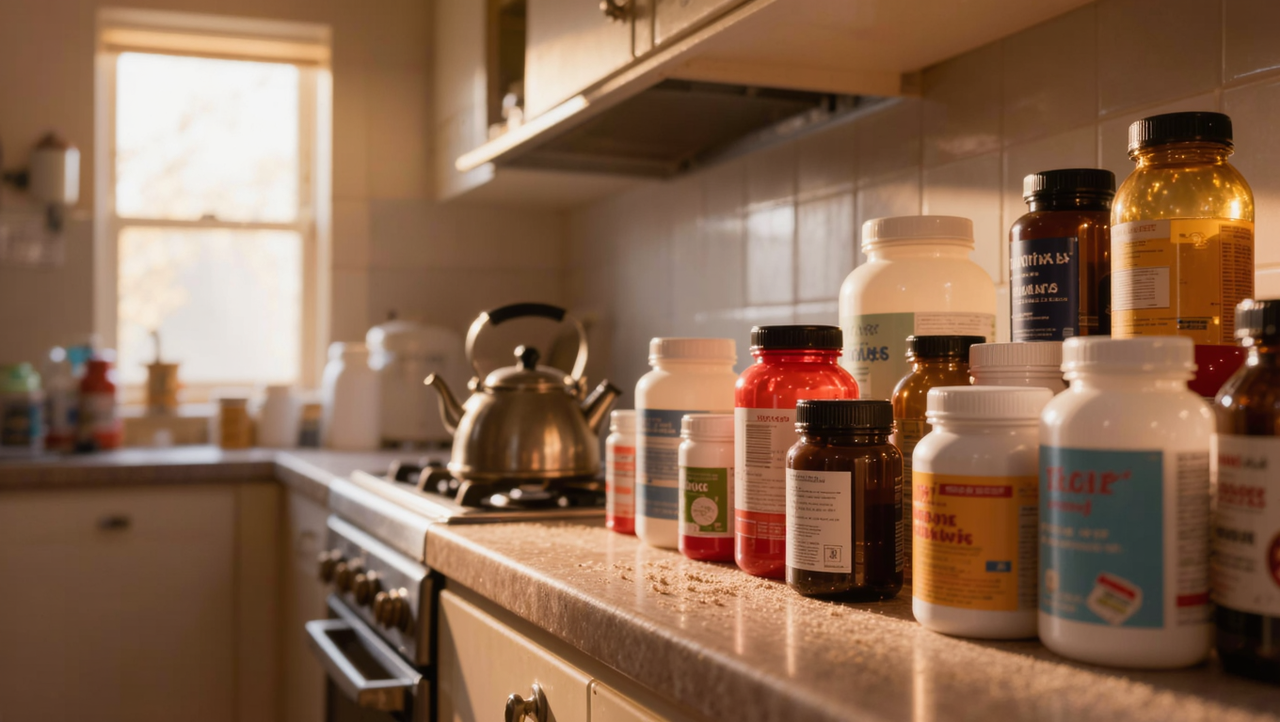


Nineteen bottles. That's what I counted when I finally stepped back and looked at my kitchen counter. NR, creatine, CoQ10, magnesium, glycine, Lion's Mane, quercetin - spread across seven brands, reordered from four different websites, with eleven recurring reminders snoozed on my phone every month. The total: €3,204 a year. €267 a month. On supplements I wasn't even taking consistently.
I'm not proud of the number. I didn't set out to spend that much. It happened the way it happens to most people in this space: you listen to a podcast, you read a study summary on Reddit, you order one more bottle. Then another. Then another. Before you know it, your morning routine involves opening seven different caps, swallowing twelve pills, and hoping you remembered the one that needs to be taken with fat.
The worst part wasn't the money. It was the guilt of knowing I was only about 60% consistent on a good week. Most weeks, worse. By Thursday I'd be cutting corners. By Sunday, half the bottles hadn't been opened since Monday. I was spending €267 a month on a protocol I couldn't even stick to.
The moment I realised they were all doing the same thing
It started with a spreadsheet. I sat down one Saturday morning and listed every supplement I was taking, the dose, the price, and what it was supposed to do. And that's when the pattern emerged.
NR, CoQ10, magnesium, B-vitamins, creatine - I'd bought them all separately, based on different podcasts and different Reddit threads. When I actually mapped what they do, they all feed into the same system: mitochondrial energy production. They're not independent interventions. They're an interconnected chain. One without the others is like putting premium petrol in a car with a broken alternator.
Every brand had sold me their piece. None of them told me how it connected. I didn't need nineteen bottles. I needed one formula that covered the whole pathway properly.

I tried the popular alternatives first
AG1
75+ ingredients in a 12-gram serving. At face value, that sounds impressive. But do the maths: that's roughly 160mg per ingredient on average. Where's the NR? Not there. Clinical-dose creatine? Not there. CoQ10? Not there. Ca-AKG? Not there.
At €87/month, AG1 is a solid greens drink with probiotics, B-vitamins, and plant extracts. But it wasn't replacing my stack. Not even close.
IM8 (the David Beckham one)
Two products: Daily Ultimate Essentials and Daily Ultimate Longevity. Combined cost: roughly €200/month (€2,400 a year). The senolytic complex is probably one of the best commercially available - resveratrol, quercetin, fisetin. Glycine at 3g. Taurine at 2g. Those are real doses.
But the NAD+ precursor sits inside a proprietary "NAD3 Complex" where you can't see the individual dose breakdown. No Ca-AKG. No creatine. No Lion's Mane. And you need both products to get the full picture, which means €200/month before you've covered the gaps.
The key insight: These products aren't bad. They're just not designed to replace a full longevity supplement stack. AG1 is a greens drink. IM8 is a premium senolytic-focused system. Neither of them covers the full mitochondrial pathway that my nineteen bottles were (inconsistently) targeting.

Where I Found It: Reddit's r/Longevity
Someone posted a comparison spreadsheet of all-in-one longevity supplements. Most were greens drinks pretending to be longevity formulas. One stood out: Longevity Complete by The Longevity Store. Twenty-four ingredients. Every dose printed on the label. No proprietary blends.
The Reddit thread had actual pharmacists and biohackers going through the label line by line. The consensus: this is the first commercial formula that covers the full mitochondrial energy pathway at real doses.
What's actually inside (every dose, no hiding)
This is the part that sold me. Not the marketing. Not the packaging. The label. Here are the doses that matter:



The TMG inclusion was what told me this formula was designed by someone who understands biochemistry, not marketing. NR supplementation increases demand for methyl groups. Without TMG to replenish them, you're creating a bottleneck. Most standalone NR products don't mention this. This formula accounts for it.
I went through the full label line by line against my old spreadsheet. It replaced 16 of my 19 bottles. The remaining three were fish oil (included free with the 3-month subscription as omega-3), vitamin D (which I get from sun exposure), and a probiotic I was already questioning.
Scientific Advisory Board

"What attracted me to The Longevity Store was their integrity. They share the belief that education precedes supplementation. As a scientific advisor, I appreciate their commitment to science-based principles and transparency in ingredient selection."

"The inclusion of TMG alongside NR is what separates this from most formulas. NR supplementation increases methylation demand — without TMG to compensate, you're creating a new bottleneck. We designed every ingredient interaction to be synergistic, not just additive."

A UCLA Professor Built This. Not a Marketing Team.
Dr. Robert Lufkin - physician and medical professor at UCLA and USC, published researcher in metabolic health. Head of the Scientific Advisory Board at The Longevity Store.
Manufactured in the Netherlands in an IFS-certified facility. Third-party tested by Eurofins. After a year of comparing products where I couldn't always see what I was getting, that transparency mattered.
"What attracted me to The Longevity Store was their integrity. Learn first, then optimise. They share the same belief that education precedes supplementation. As a scientific advisor, I appreciate their commitment to science-based principles and transparency in ingredient selection."
| Key Ingredient | Longevity Complete | AG1 | IM8 (both) |
|---|---|---|---|
| NR (NAD+ precursor) | 300mg | NMN (undisclosed) | |
| Creatine | 3,000mg | ||
| Ca-AKG | 1,140mg | ||
| CoQ10 | 100mg | ||
| Glycine | 2,000mg | 3,000mg | |
| Lion's Mane | 455mg | ||
| Magnesium (quality forms) | 500mg | ||
| TMG / Betaine | 1,000mg | ||
| Price/month | €49 | €87 | €200 |
What I noticed after 90 days
I want to be honest here. I'm not going to tell you this changed my life overnight. Longevity supplements don't work like that. But after three months of consistent daily use - 100% compliance, which never happened with the 19-bottle protocol - here's what I noticed:

Energy: The Afternoon Dip Is Mostly Gone
The 2-3pm crash that had me reaching for a second (or third) coffee has mostly resolved. It didn't happen in week one. Around week three, I noticed I was getting through the afternoon without the usual slump. By month two, it was consistent enough that I stopped thinking about it.
I went from three coffees a day to one. Not because I was trying to cut back. I just stopped needing them.

Sleep: Higher Scores, Better Mornings
I track sleep with an Oura ring. My sleep scores have gone from averaging around 72 to consistently hitting 80+. I'm guessing the glycine (2,000mg) and magnesium taurate are doing the heavy lifting here - both are well-researched for sleep quality.
I wake up feeling more rested. Not "I slept 12 hours" rested. More like "I actually recovered" rested. The kind where you get out of bed without bargaining with the alarm.

Recovery: Leg Day Went From 4 Days to 48 Hours
This one surprised me. I train four times a week and leg day used to write me off for the better part of a week. Creatine at 3,000mg and CoQ10 at 100mg are both supported by research for exercise recovery, and the difference was noticeable within the first month.
I can train again 48 hours after a heavy session instead of limping around until Thursday. That's not a marginal improvement. That's an extra training day per week. (Individual results may vary.)
What I can't tell you: whether my NAD+ levels changed or my biological age shifted. I didn't do bloodwork yet - planning to at the six-month mark. The longevity stuff is a long game. I'm playing it. But the short-term benefits - energy, sleep, recovery, consistency - those are real and I can feel them.
Who this is for (and who it isn't)
I've been asked by enough people now that I can describe the three types who tend to benefit most:
1. The cluttered counter person. You've got multiple expired bottles, a supplement routine you can't stick to, and a vague sense of guilt every time you look at the shelf. You don't need more bottles. You need fewer, better ones.
2. The AG1 or IM8 questioner. You're paying €87-200/month and you've started wondering whether you're actually getting clinical doses of the ingredients that matter for longevity. You want to see every dose on the label, not behind a proprietary blend.
3. The science-first sceptic. You prioritise published research, transparent dosing, and credentialed formulators over celebrity endorsements and Instagram aesthetics. You want to verify the doses against the literature yourself.
If none of these describe you, this probably isn't the right product. If one of them does - it's worth looking at the label.

The Maths: Over €2,600 a Year Saved
€267/month became €49/month. That's €218 saved every month, €2,616 a year. Not by taking less - the coverage is actually better. And the 3-month subscription includes omega-3 as a free gift, which covered the last gap in my stack.
One scoop takes thirty seconds. I haven't missed a day in three months. The best supplement protocol is probably just the one you actually stick to. That turned out to be the most important optimisation of all.
Customer Reviews
4.8 out of 5 · 850+ reviews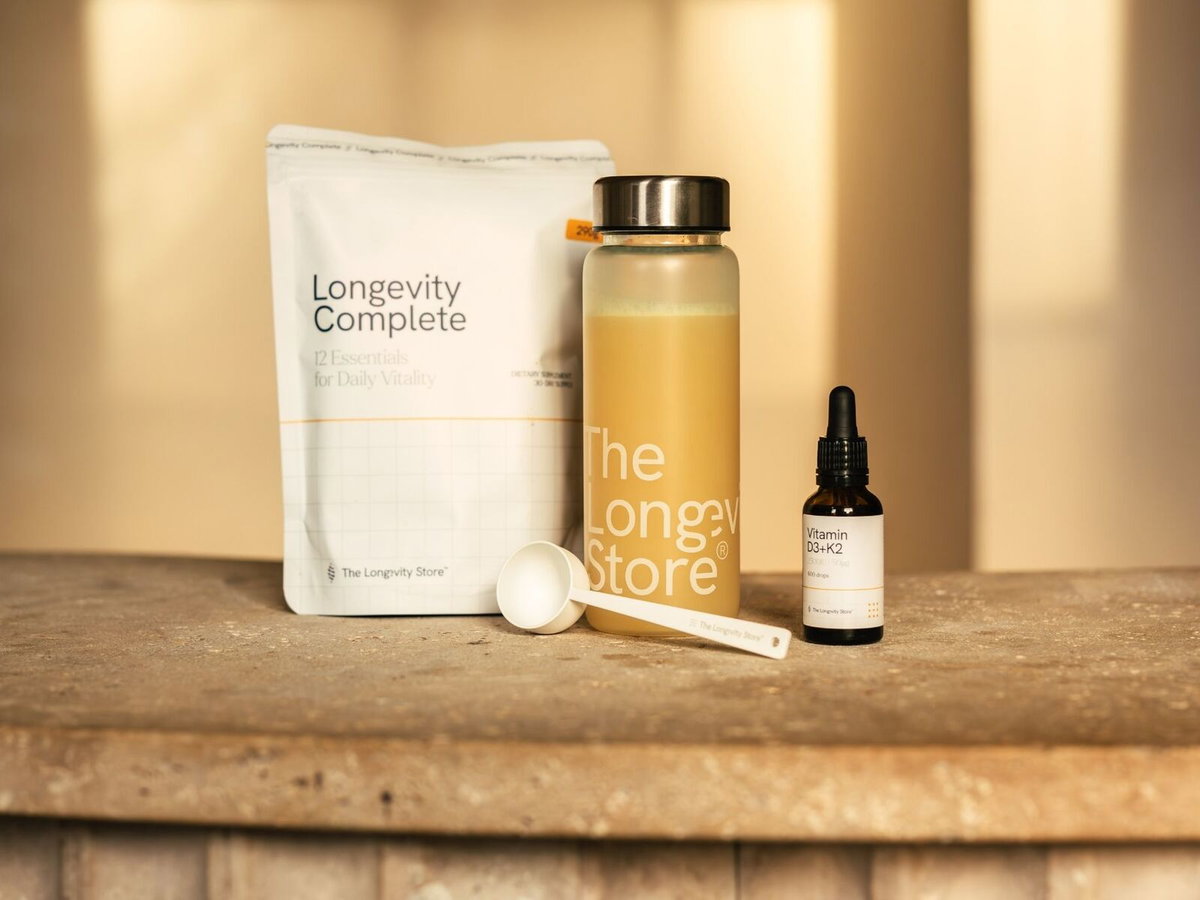
€267/Month Became €49. One Scoop. Done.
✓ 24 ingredients at clinical doses - every dose on the label
✓ €49/month on subscription (was €267 buying separately)
✓ Ships every 90 days - free omega-3 included with subscription
✓ 30-day money-back guarantee
✓ IFS-certified. Eurofins tested. Made in the Netherlands.
Formulated by Dr. Robert Lufkin, UCLA & USC Professor of Medicine. No proprietary blends. No marketing doses.
If you're the person with the cluttered counter and the expired bottles - this is what fixed it.
